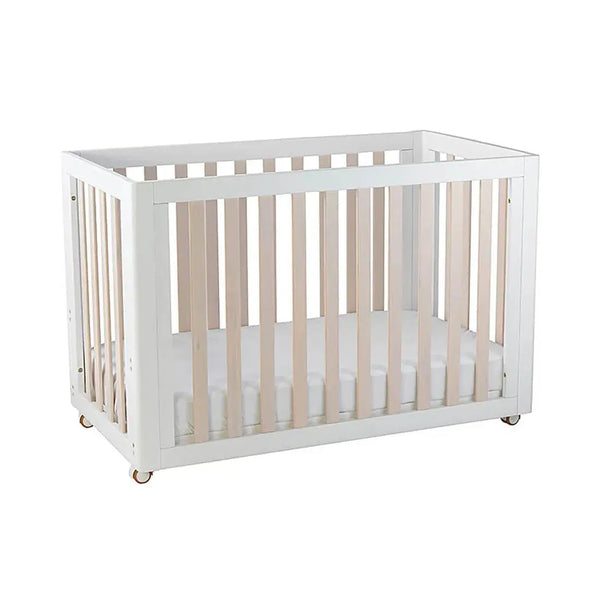
What Makes a Cot ‘Compact’?
When space is tight, choosing furniture with a smaller footprint can make a noticeable difference. Compact baby cots give your little one a dedicated place to sleep while leaving more room for the change table, drawers or comfortable movement around the cot. Here’s how compact cot sizes compare with standard cots:
- Compact cots - Typically around 124 cm long and 70-75 cm wide.
- Standard cots - Roughly 140 cm long and 75 cm wide.
That difference can be particularly useful if you plan to move the cot between rooms. Many compact cots can also fit through standard doorways while assembled, although dimensions vary, so measure your doorways and check the cot’s specifications before buying.
Compact Cot, Bassinet or Portacot: Which One Suits You?
The right choice depends on your available space, daily routine and how you plan to use the sleep space.
A bassinet or cradle is a cosy, practical option for the newborn months, while a compact cot can be used from birth for longer-term sleep. Portacots, meanwhile, are designed to offer a portable sleep option for travel or visits to family, depending on the model’s intended use.
|
Cot type
|
How long will you use it?
|
Size
|
Is it suited to nightly sleep?
|
|
Bassinet
|
Usually the first few months, until your baby reaches its limits
|
Small and compact, ideal beside your bed
|
Yes, when designed and approved for infant sleep
|
|
Compact cot
|
From birth through the early stages, depending on the cot’s limits
|
Around 124-125 cm long and 70-75 cm wide
|
Yes, designed for regular sleep
|
|
Portacot
|
Varies by model and its age, weight and size limits
|
Foldable, with a packed size that varies by design
|
Some are suitable for regular sleep; check the manufacturer’s instructions
|
Starting with a compact cot means you may be able to skip the bassinet and choose a sleep space for longer-term use from birth. The trade-off is that a standard baby cot generally requires more space beside your bed than a bassinet.
Getting the Right Mattress Fit for Your Compact Cot
A compact cot requires a mattress sized to the manufacturer’s specifications, rather than a standard cot mattress. Even a small gap between the mattress and cot sides can pose a safety risk, so confirm the required dimensions before making your purchase.
Once you’ve confirmed the size, browse our baby cot mattresses and cot sheets to find options suited to your compact cot.
How Long Will a Compact Cot Last?
Most compact cots are designed for use from birth to around three years, depending on the model and your child’s growth. Adjustable mattress heights let you start with a higher base for easier access, then lower it once your baby can pull themselves up.
Some models also offer features that extend their versatility or make them easier to use:
- Cocoon Piccolo Cot - Converts into a toddler bed by removing one side and adding a toddler bed rail.
- Boori Natty Compact Cot - Features two adjustable base heights and lockable castors for moving the cot between rooms.
- Boori Turin Compact Cot - Recommended from birth to around three years.
- Seena Mosman Cot - Recommended from birth to around two years and converts from bassinet height to cot height.
Once your little one outgrows their cot, you’ll need to consider a toddler bed or another suitable sleep option. Check the individual cot’s age guidance and conversion details to understand how long it is intended to be used.
Australian Safety Standards for Compact Cots
When choosing compact cots in Australia, check that the cot complies with AS/NZS 2172, the Australian standard for household cots.
Most designs have two mattress base heights: a higher position for newborns and a lower position once your baby can sit up or pull themselves up. Always follow the manufacturer’s instructions for when to lower the base.